Build a Simple Decision Support System
In the last post, we explored why small businesses don’t need complex systems like data warehouses to get value from their data.
What they need instead is a Decision Support System (DSS) - a simpler and more practical way to use data for decision-making.
A Decision Support System is a structured way to use data to make better business decisions. It helps businesses organize information, reduce guesswork, and make well-informed choices using timely and relevant data. With a DSS, you can:
Turn raw data into insights
Turn insights into strategic decisions
Improve business outcomes over time
The 4-Step DSS Framework for Small Businesses
Small businesses can implement a DSS using four simple steps:
Define the business question
Identify the data and data sources
Translate the data into simple metrics
Make decisions
Let’s break this down.
Define the Business Question
Start with the problem, not the data. Ask questions that help you identify the business decision you need to make.
Ask questions like:
What is selling the most?
Which products are most profitable?
Who are my best customers?
Where can I reduce costs?
What product combinations can boost sales?
What is the optimal pricing strategy to maximize profit in Q2?
Once you define the right questions, your data becomes focused and ready for use.
Identify the Data and Data Sources
Next, determine what data you already have and the sources for all the data. Decide what variables or factors are relevant for the decision support, such as cost, competition, demand, and customer behavior.
Common data sources include:
Sales records
Customer orders
Website analytics
Marketing reports
When identifying data sources, the goal is to combine and focus only on the data needed to answer your business questions. This helps reduce confusion and keeps your analysis focused.
Turn Data into Simple Metrics
Raw data alone doesn’t drive decisions, but metrics do. Metrics simplify complex business performance into numbers that are easier to track and interpret.
Some examples include:
Revenue - How do we increase revenue by Q3?
Profit margin - What products generate the most profit?
Conversion rate - How can we convert leads into customers?
Customer retention rate - How can we improve repeat purchases?
These metrics highlight what’s working, what needs improvement, and how to go about achieving it.
Make Decisions
This is the most critical step. Your metrics should help guide decisions such as:
What should you change?
What should you improve?
What should you scale?
Data only becomes valuable when it leads to clear, actionable decisions.
Applying the DSS to Bessie’s Skincare
Let’s see how this works in practice using Bessie’s product performance data.
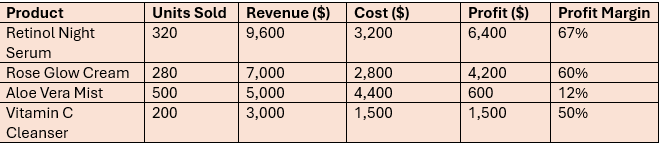
Many small businesses focus on what sells the most instead of what generates the most profit.
Step 1: Ask the Right Question
Which product drives the most profit?
Which products should receive more marketing investment?
How can we improve the profit margin for Aloe Vera Mist?
What strategies can improve profitability without reducing sales?
Step 2: Identify the Data
Product sales
Revenue per product
Cost per product
Step 3: Create Metrics
Profit margin per product
At first glance, Aloe Vera Mist appears to be the best-performing product with the highest number of units sold (500). However, the DSS shows that despite strong sales volume, it generated the lowest profit margin at 12%.
In contrast, Retinol Night Serum generated the highest profit margin at 67%, making it the most profitable product overall. Even though Vitamin C Cleanser sold fewer units (200), it still produced a significantly healthier margin than Aloe Vera Mist.
Step 4: Make a Decision
Increase marketing investment in high-margin products like Retinol Night Serum
Review pricing strategies for low-margin products like Aloe Vera Mist
Reduce production and packaging costs where possible
Bundle low-margin products with high-margin products to improve profitability.

Applying This to Your Business
This is how a DSS helped transform Bessie’s raw business data into practical business action. Now it’s your turn.
Choose one question that matters to your business and walk through the four steps.
A simple spreadsheet of your data or a dashboard is enough to begin building a DSS.
The goal is to build a Decision Support System that makes you understand your data, discover insights, and make better business decisions.
