Data and Decisions: How Small Businesses Can Do More With the Data They Already Have
The Pressure to ‘Do More’ With Data
Small and medium-sized businesses today face a quiet but constant pressure to do more with their data. With trends in every industry like Big Data, AI, Automation, and Advanced Analytics, it can feel like you are falling behind if you are not using complex systems. At some point, the question comes up: Do I need a data warehouse?
If you find yourself at this crossroads, here’s all you need to know about having a data warehouse for your business.
What is a data warehouse?
A data warehouse is a system that collects and stores data from different data sources into a central location for analysis. Think of it as a regular warehouse that stores physical products, raw materials, and goods before they are sold, distributed, or used in production. Only this time, it houses the data you collect at different times and from different places (customer, sales, inventory, marketing), before it is analyzed to gain insights.
Snowflake, Redshift, and BigQuery are good examples of data warehouses that are built for high-volume datasets. When small businesses use data warehouses, it can be likened to buying an industrial oven to bake one cupcake. That’s an overload on infrastructure, maintenance, and cost overhead, and the benefits rarely justify the cost.
Typically, most businesses move through:
· Spreadsheets
· CRMs or other analytical tools like Google Analytics, HubSpot, or Square Analytics.
· A lightweight database or BI tool like Airtable, Metabase, or Looker Studio.
· A cloud data warehouse when the volume and data complexities demand it.
Questions to ask to determine if you need a data warehouse?
1. Do you make decisions frequently enough that stale data slows you down and costs you money?
2. Do you have data coming from multiple sources that need to be manually combined?
3. Do you have someone to manage (query, combine, analyze) your data?
Data and Decisions
Many businesses struggle because:
· They don’t know what questions to ask
· They don’t know how their numbers really matter
· They don’t know what to do with the data
This lack of clarity gets them stuck because they already have the main tool- the data-what they need is a better way to think with their data.
What options do you have?
Rather than use a data warehouse, which is a premature move, small businesses have the option of a Decision Support System. A Decision Support System (DSS) is not just a tool, but a structured way of using your data to guide your decisions, and it doesn’t require a warehouse; it can be built using the data you already have. It helps you:
· Process large amounts of data at a fast rate
· Ask the right business questions
· Improve data management without requiring a data engineer
· Turn data into insights that you can act on
· Promote team collaboration
A Real-Life Example
Bessie’s Skincare is expanding steadily. She recently organized her data and is learning to track:
· Orders for beauty products
· Revenue per order
It wasn’t always this way. Previously, she relied on guesswork and promoted products she felt were popular based on demand, and priced her products based on her competitors.
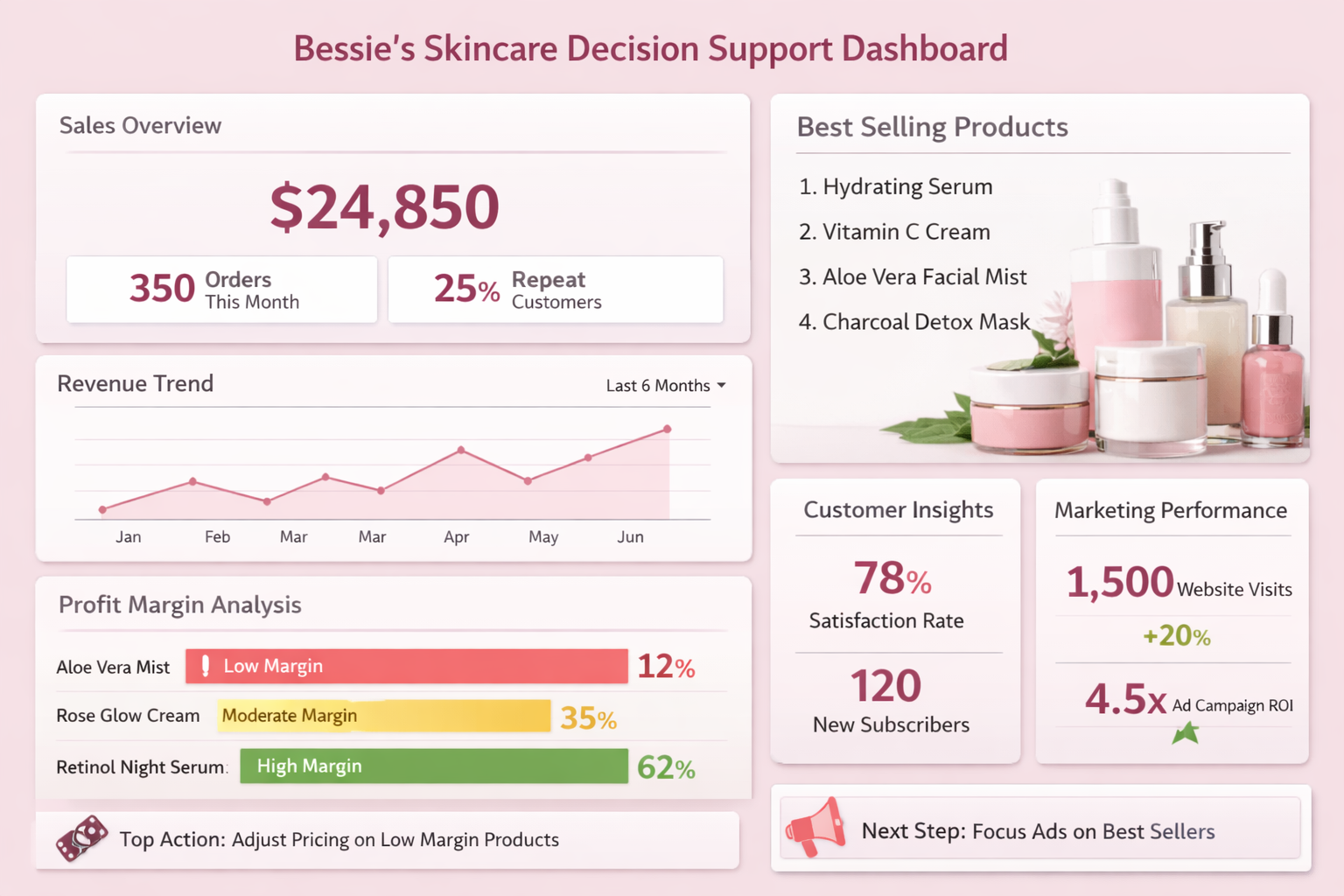
Image generated by Chat GPT
After applying a simple Decision Support System, she discovered that Aloe Vera Mist sells frequently but has very low profit margins (12%).
With this insight, she can:
Improve profitability by adjusting pricing, reducing production costs, or bundling low-margin products with high-margin items (like Aloe Vera Mist and Retinol Night Serum)
Scale high-performing products by increasing ad spend on top sellers like Retinol Night Serum and Rose Glow Cream
Strengthen customer retention by implementing email or SMS strategies to convert website visitors into repeat buyers
Identify revenue leakage and take action to reduce losses across products or operations
Make data-driven growth decisions by focusing on what’s working and optimizing what isn’t
Now, Bessie no longer guesses, but makes data-based decisions. This is the point where small businesses need to shift their focus – from guesswork to data-driven decisions.
What This Means for You
A data warehouse is not your first step - clarity is.
Asking the right business questions unlocks the value in your data, and a decision support system helps you do just that. The real question is:
How do you actually build a Decision Support System using the data you already have?
In the next post, I’ll walk you through:
Creating a simple DSS framework
Applying it step-by-step
And how to start making better decisions immediately
Need help?
You can start with a simple structure using tools like Excel or Google Sheets, or download my free toolkit designed to help you organize your data and take action.
